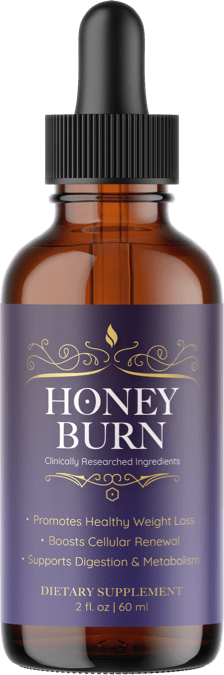
HoneyBurn review: how much berberine is really in it
A honey-based liquid with a full ingredient list. By labeling rules, its headline ingredient, berberine, is the smallest one in the blend.
Check HoneyBurn price on the official siteThe short version
- What it is: a liquid supplement in a 60 ml dropper bottle. One daily serving is 2 ml, and it holds a 550 mg “Royal Honey Blend” of 11 ingredients: bee products, honey, plant extracts and berberine. The front label says it supports digestion and metabolism and promotes healthy weight loss.
- Good: the full ingredient list is published. US shipping is free. The 60-day refund accepts opened and empty bottles.
- Concerns: berberine is listed last, so a serving holds at most about 4 mg of it (trials use 1,000–1,500 mg a day). The label itself says “The safety of this product has not been determined.” Bee pollen, royal jelly and propolis can trigger allergies. The headline “burns fat 4x faster than keto” cites no study.
What’s actually on the label
The Supplement Facts panel is published on the official References page. In a proprietary blend, FDA labeling rules require the ingredients to be listed from most to least by weight. That lets you estimate amounts even though individual doses aren’t shown. The whole blend is 550 mg per 2 ml serving.
| Ingredient (label order) | What we can say |
|---|---|
| 1. Raspberry (seed) | Listed first, so it is the largest ingredient by weight. |
| 2. Raw wildflower honey | Less than 550 mg per serving. For scale, a single teaspoon of honey weighs about 7 g, so one serving holds under a tenth of a teaspoon. |
| 3. Bee pollen, 5. Royal jelly, 7. Bee propolis extract | These are bee products. People with pollen or bee allergies, or with asthma, should be careful. |
| 4. Sodium alginate | A thickener made from seaweed. |
| 6. Kudzu root extract (40% isoflavones) | Isoflavones are plant compounds. The seller’s kudzu references are mostly cell and rodent studies. The one human weight study it cites used kudzu flower extract, not root. |
| 8. Holy basil leaf extract | For this ingredient the seller cites an overview on a herbal company’s website, not a clinical trial. |
| 9. Purple carrot powder | The label gives the Latin name Raphanus sativus, which is radish, not carrot. It is a small error, but it says something about how carefully the label was prepared. |
| 10. Olive leaf extract (20% oleuropein) | A small amount, second to last in the blend. |
| 11. Berberine hydrochloride extract 8% (Phellodendron amurense bark) | As the last of 11 ingredients, it can weigh at most about 50 mg. At 8% berberine, that is about 4 mg of berberine or less. Berberine trials typically use about 500 mg two or three times a day. |
Price per bottle and per day
Each bottle holds 30 servings: $2.30 a day for one bottle, $1.97 in the 3-bottle bundle and $1.63 in the 6-bottle bundle. If you take the optional second serving, the cost doubles and a bottle lasts 15 days. US shipping is free and takes 5–7 working days. Canada, the UK, Ireland, Australia and New Zealand pay $15.95 and wait 10–15 working days.
30-day supply
Free US shipping
90-day supply
Free US shipping
180-day supply
Free US shipping
The refund policy, in plain English
- You have 60 days from the delivery date.
- Email support with “Refund Request” in the subject. Then send back all bottles, opened or empty, together with the packing slip.
- You pay the return shipping. Returns go to Tallmadge, Ohio.
- The policy recommends using the product for at least 3 months, which is longer than the refund window.
Marketing claims vs. evidence
The headline of the video sales page reads “This Purple Honey Burns Fat 4x Faster Than Keto”. We found no study comparing HoneyBurn, or any honey product, with a ketogenic diet.
The page lists 22 scientific references. Several relate to honey, royal jelly, berberine or kudzu. Others have nothing to do with weight or digestion:
- a study on doctors touching patients during primary care visits;
- heart scans after coronary bypass surgery;
- a diabetes self-management program;
- supplements and cognitive performance in military personnel.
The berberine studies cited range from cell experiments to a meta-analysis of clinical trials. None of them tested a few milligrams of berberine in a honey blend.
Who should be careful
- People with allergies to bees, pollen or honey, and people with asthma.
- Anyone pregnant or nursing.
- Anyone taking prescription medication, especially for diabetes, blood pressure or blood thinning. Berberine can interact with several medicines. The dose here appears very small, but the label itself says safety hasn’t been established.
If you’re curious about berberine itself: standalone berberine products are dosed in hundreds of milligrams per capsule. Because of the drug interactions, discuss it with a doctor or pharmacist first.
Questions people ask about HoneyBurn
Does HoneyBurn work?
We found no study of HoneyBurn itself. Its headline ingredient, berberine, is listed last in a 550 mg blend, so a serving holds about 4 mg of berberine at most. Berberine trials use 1,000–1,500 mg a day.
What are the side effects?
The label itself says “The safety of this product has not been determined.” It contains bee pollen, royal jelly and propolis, which can trigger allergies, and berberine, which can interact with several medicines.
Is HoneyBurn real honey?
Raw wildflower honey is the second ingredient in a 550 mg blend per 2 ml serving. One serving holds less than a tenth of a teaspoon of honey.
Where can I buy HoneyBurn?
Through its official website, with checkout handled by BuyGoods: $69 for one bottle, $59 each for 3 and $49 each for 6, with free US shipping. If you see it sold elsewhere, compare the label and refund terms with the official site.
Can people with diabetes take it?
Ask your doctor first. HoneyBurn contains honey and berberine, and berberine can add to the effect of diabetes medicines. The label says its safety hasn’t been determined.
Also on this site: Gut Save vs DigestiStart vs GutOptim and Supplements for bloating and constipation.
Sources
- HoneyBurn official site: Supplement Facts label (References page, thehoneyburn.com/help/references.php), prices, Shipping Policy and Refund Policy. Checked October 15–16, 2026.
- U.S. Code of Federal Regulations, 21 CFR 101.36: nutrition labeling of dietary supplements (proprietary blends listed in descending order of predominance by weight). ecfr.gov
- Berberine doses used in clinical trials and drug interactions: Drugs.com: What is berberine used for?
- Kamiya T. et al. Consumption of Pueraria flower extract reduces body mass index via a decrease in the visceral fat area in obese humans. Biosci Biotechnol Biochem, 2012. doi:10.1271/bbb.120235